A Step-by-Step Guide to Biodiversity Net Gain
What Does BNG Mean for Developers? A Step-by-Step Guide to Biodiversity Net Gain
Before a development can move forward, there's an important requirement developers need to factor into their plans: Biodiversity Net Gain (BNG). Under mandatory BNG rules in England, developers must demonstrate at least a 10% increase in biodiversity compared with the site's pre-development value. This involves assessing the site's existing biodiversity, calculating the gains required, identifying how those gains will be achieved and putting the necessary arrangements in place before development begins.
For developers in England, BNG is more than a planning requirement. It can affect site design, developable land, project costs and planning timelines.
So, what does BNG mean for your project, and how do you work through the process?
Step 1: Understand the 10% Biodiversity Net Gain Requirement
Biodiversity Net Gain (BNG) is a legal requirement under the Environment Act 2021. It requires developers to leave biodiversity in a measurably better state than before development.
Under England's mandatory BNG rules, developments that fall within the scope of the legislation must deliver at least a 10% increase in biodiversity value.
Example:
For example, if your site has an existing biodiversity value of 10 units, you need to achieve a post-development biodiversity value of at least 11 units to meet the 10% gain target.
However, the calculation is not simply about adding one extra unit. If development removes or damages existing habitats, their biodiversity value must also be accounted for. You need to provide replacement habitat units that compensate for those losses, as well as deliver the additional 10% gain. These replacements must follow the metric's habitat trading rules, which determine what types of habitats can be used to compensate for those lost.
Calculation Guidelines:
The statutory biodiversity metric calculates these figures by measuring the site's biodiversity value before development and comparing it with the expected value after development, including habitats lost, retained, created and enhanced. This determines whether the development meets the required 10% gain.
For developers, this means understanding the site's existing habitats and how the proposed development will affect them.
The required gain can be delivered through three routes:
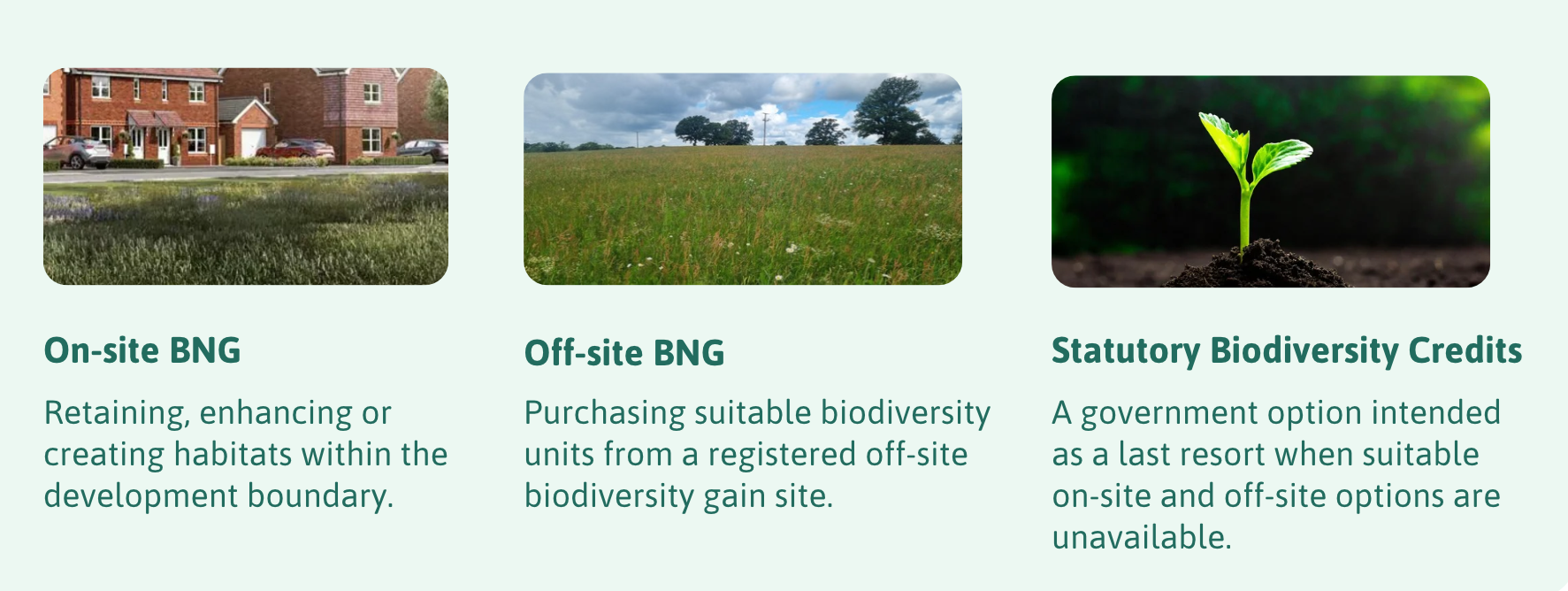
These routes can be combined to create a single BNG strategy for a site. The BNG requirements for your development will depend on the habitats already present on the site, which habitats will be affected by the proposed development and how the biodiversity gains can be delivered.
It's also important to check local planning policies, as some local authorities require more than 10% Biodiversity Net Gain.
Tip: Consider BNG early in the planning process to give you more time to understand the requirements and develop the most effective strategy.
Step 2: Calculate Your BNG Requirement Using the Statutory Biodiversity Metric
The Statutory Biodiversity Metric is used to calculate the biodiversity value of a site before and after development. It helps establish the baseline, assess the impact of the proposed development and determine what is needed to achieve the required Biodiversity Net Gain (BNG).
The on-site assessment should be carried out by a suitably qualified ecologist, who can assess the site's existing habitats, record their condition and calculate their biodiversity value using the statutory metric.
What does the biodiversity metric include?
The metric has three main categories of biodiversity units:
· Area habitats: Habitats such as grassland, woodland and lakes, measured by area.
· Hedgerows: Hedgerows and other eligible linear features, measured by length.
· Watercourses: Rivers, streams and other eligible watercourse habitats, assessed using the relevant watercourse module.
These categories are assessed separately. Their units cannot simply be added together to meet the overall requirement. Each applicable category must meet its own BNG target.
The metric also considers factors such as:
· Habitat type and size: The type of habitat present and the area or length it covers.
· Distinctiveness: How ecologically distinctive the habitat is, which influences its biodiversity value and the trading rules that apply.
· Condition: The current quality of the habitat.
· Strategic significance: Whether the habitat is in a location identified as important for biodiversity.
· Habitat creation and enhancement: The types of habitats that can be created or improved, the work involved in establishing them and the time needed for them to reach their target condition.
Together, these factors determine the site's biodiversity value in units, both before and after development. The metric then shows the biodiversity gains required to meet the 10% BNG target.
Getting your biodiversity metric right is essential to understanding your Biodiversity Net Gain requirements. At BNG Partnership, we can review your completed metric, understand your unit requirements and identify suitable off-site units where needed.
How do you complete the biodiversity metric?
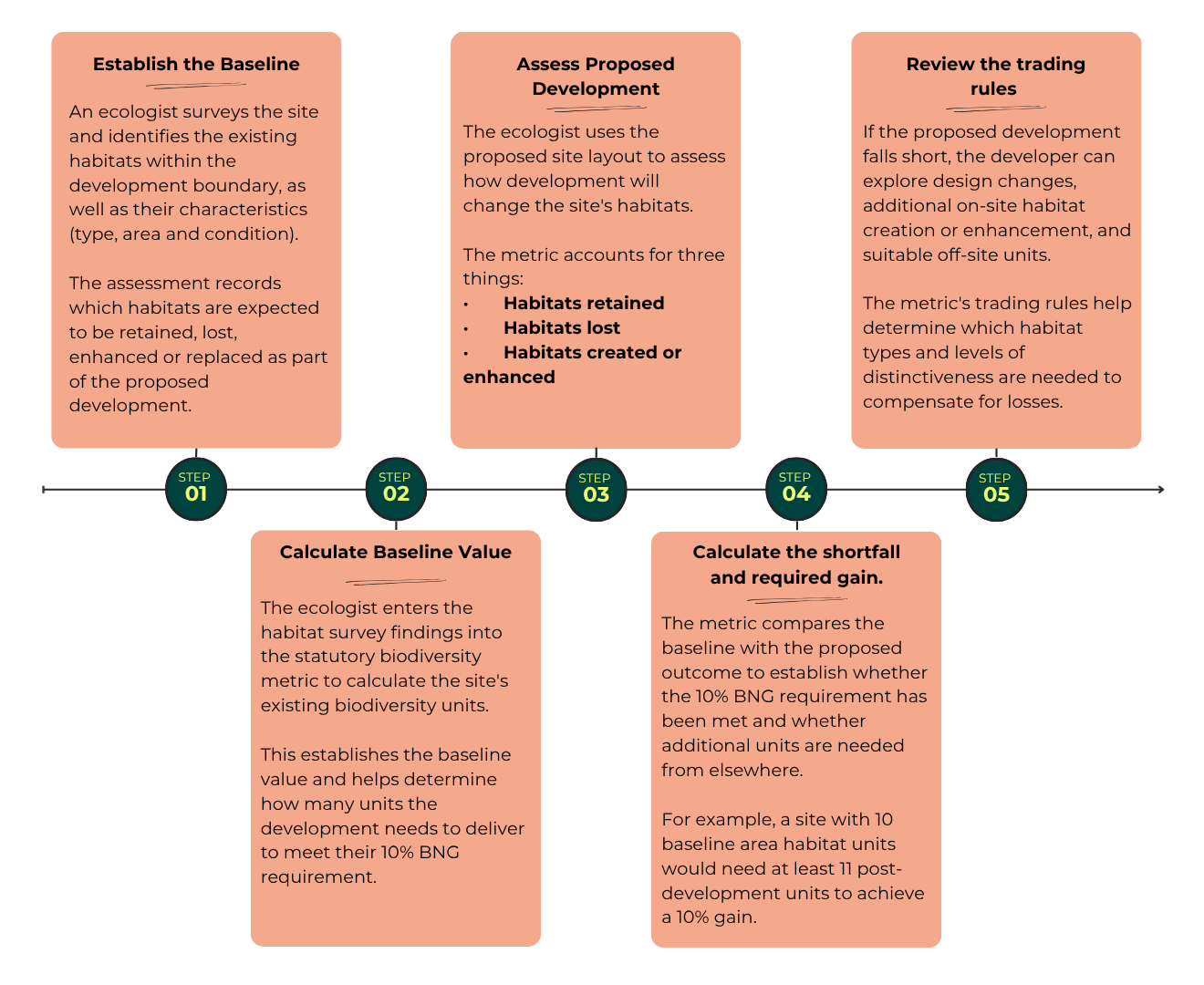
Off-site units must also meet the relevant spatial requirements.
The metric can be updated as the proposal develops.
The biodiversity metric is more than a planning document. It helps developers understand their obligations, assess the impact of design decisions and identify where additional provision is needed.
Tip: Make sure you understand the biodiversity value of each habitat category. Area habitats, hedgerows and watercourses are measured separately, and their units cannot be combined.
Step 3: Check the BNG Trading Rules Before Buying Biodiversity Units
A shortfall in biodiversity units does not automatically mean that any available units can be used to meet your BNG requirement. The proposed off-site units must comply with the statutory biodiversity metric's trading rules, which determine which habitats can replace those lost through development.
A habitat loss must be compensated for with a habitat of equal or higher distinctiveness, with additional requirements depending on the habitat type and its distinctiveness.
For area habitats, the rules work as follows:
- Low-distinctiveness habitats: Can be replaced by habitats of the same or higher distinctiveness.
- Medium-distinctiveness habitats: Must be replaced by a habitat of the same broad habitat type and distinctiveness, or by a habitat of higher distinctiveness.
- High-distinctiveness habitats: Must be replaced by the same habitat type.
- Very-high-distinctiveness habitats have the strictest requirements and require the same habitat type, subject to the applicable metric rules.
The precise requirements depend on the specific habitat lost and its statutory trading rules.
This means that two habitat banks with the same number of available units may not be equally suitable for your development.
Before purchasing off-site units, developers need to check that the proposed units meet the trading rules and the relevant spatial requirements. Our matching tool provides an instant analysis of potential trading options. Contact us to review your requirements.
Tip: Don't look at the number of units alone. Check that the habitat type is suitable for your development before committing to a purchase.
Step 4: Understand How Location Affects Your BNG Costs
The location of an off-site habitat bank affects how much its biodiversity units count towards a development’s BNG requirements. The further the habitat bank falls outside the relevant area, the more units a developer may need to purchase.
For area habitats and hedgerows, the rules are based on Local Planning Authority (LPA) and Natural Character Area (NCA) boundaries:
- Within the same LPA or NCA: The units count at their full value, with a score of 1.0.
- Within a neighbouring LPA or NCA: The units count at 75% of their value, with a score of 0.75.
- Outside the direct and neighbouring areas: The units count at 50% of their value, with a score of 0.5.
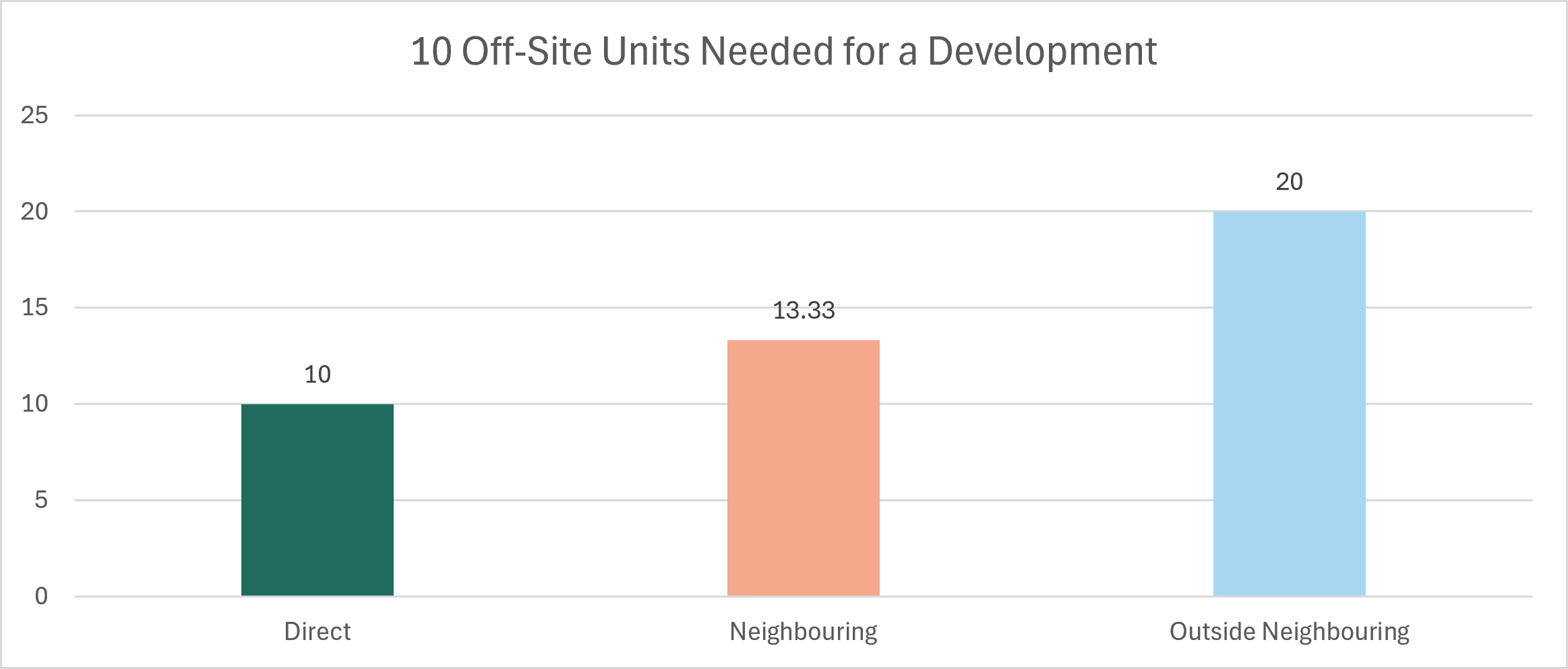
For example, if a development needs 10 biodiversity units, a neighbouring habitat bank with a score of 0.75 would require around 13.33 units to meet that requirement. Using a more distant bank with a score of 0.5 means the developer would need 20 units.
For watercourses, the same principle applies, but the boundaries are different:
- Within the same waterbody catchment: Units count at their full value (score of 1.0).
- Within the same operational catchment, but outside the waterbody catchment: Units count at 75% of their value (score of 0.75).
- Outside the operational catchment: Units count at 50% of their value (score of 0.5).
A lower score means more biodiversity units will be needed to meet the development's BNG requirement, which increases the overall cost of purchasing off-site units. This is why checking a habitat bank's location is important when comparing your options.
However, the closest habitat bank is not automatically the best choice. Developers should also consider habitat suitability, trading rules, available units and price when deciding which option works best for their development.
Explore our habitat banks to see the available units and locations that could meet your BNG requirements.
Tip: Check the spatial requirements before choosing a habitat bank. A more distant site may mean you need to purchase more units, so compare location alongside habitat suitability, availability and price to find the right option for your development.
Step 5: Planning Your On-Site and Off-Site BNG Strategy
Once you understand your site's biodiversity requirements, you need to consider how you will meet them through on-site or off-site habitat provision, or a combination of the two.
The approach depends on the type of development and the planning policies that apply. For major developments (at least 10 dwellings or 1000sqm), developers must prioritise on-site mitigation. This means developers must first look at how to avoid or reduce impacts on existing habitats, then consider delivering gains on-site before using off-site provision. Minor developments do not have this prioritisation and can choose to meet their BNG requirements entirely through off-site units, if that is the most suitable approach.
Where both options are being considered, developers should assess the opportunities within the development site alongside the benefits of securing units from established habitat banks. This helps identify how on-site and off-site provision can work together to meet the BNG requirement.
Significant on-site habitats and all off-site habitats must be managed and monitored for at least 30 years. This requires appropriate management plans and legal arrangements to ensure the habitats remain compliant over that period.
On-site BNG: Integrating nature into development
On-site BNG involves retaining, enhancing or creating habitats within the development boundary.
Well-planned green spaces, trees and wildflower areas can give residents opportunities to connect with nature. Smaller pockets of habitat can also link together to form wildlife corridors, helping species move between territories.
However, developers need to consider how habitat provision fits into the site layout. Land allocated to habitats may affect the space available for buildings and infrastructure, alongside the costs of habitat creation, management and monitoring.
Off-site BNG: Nature restoration at scale
Off-site BNG allows developers to secure biodiversity units from registered biodiversity gain sites. These sites bring habitat creation and enhancement together across larger areas, often in locations identified as important for nature recovery.
By concentrating habitat improvements in one place, habitat banks can create larger, more connected areas for biodiversity and deliver wider environmental benefits. Some practical benefits of off-site provision include:
- More flexibility in site design: Reducing pressure on land needed for buildings and infrastructure.
- Access to suitable habitats: Sourcing the habitat types and quantities needed from registered habitat banks.
- Established management arrangements: The habitat bank is managed and monitored under legally binding agreements, so developers do not need to manage the off-site land themselves.
Developers must still ensure that off-site units meet the relevant trading and spatial rules and that all BNG obligations are fulfilled.
Combining On-Site and Off-Site BNG
The right approach will depend on the development site, the habitats involved and the planning policies that apply. On-site green spaces can bring nature into a development, while off-site habitat banks deliver larger, more connected areas of habitat elsewhere.
Considering both options together helps developers make the best use of their site, understand the available opportunities and plan how to meet their BNG requirements efficiently.
Tip: Assess on-site opportunities and off-site habitat options at the same time. Consider how they can complement each other, taking into account the site layout, planning policies, habitat suitability, location and management requirements.
Step 6: Update Your Biodiversity Metric with Your Proposed BNG Solution
Once you have worked out your combination of on-site and off-site BNG, you need to update your statutory biodiversity metric to reflect your proposed approach.
This means entering the habitats that will be retained, lost, created or enhanced on-site, alongside the off-site biodiversity units you intend to purchase.
The updated metric calculates the expected biodiversity value after development and confirms whether your proposed solution meets the required 10% BNG.
If the figures show that your development still falls short, you may need to revisit your proposed habitat gains or explore additional off-site units.
Tip: Update your biodiversity metric to reflect your final BNG strategy, including all proposed on-site gains and off-site units. Remember to revisit the calculations if your development layout or habitat proposals change.
Step 7: Prepare Your Biodiversity Gain Plan for Planning Approval
What is a Biodiversity Gain Plan?
A Biodiversity Gain Plan (BGP) is a document that explains how a development will meet its BNG requirements. It brings together the completed biodiversity metric, habitat plans and details of the proposed on-site and off-site gains.
The BGP is submitted to the Local Planning Authority (LPA) for approval after planning permission has been granted and before development can begin. Developers can also share a draft with the LPA earlier in the planning process.
What needs to be included in a Biodiversity Gain Plan?
A Biodiversity Gain Plan must include:
- Biodiversity metric calculations: The completed statutory metric showing the pre-development and post-development biodiversity values.
- Habitat plans: Plans showing the relevant pre-development and post-development habitats, drawn to an identified scale and showing north.
- Steps taken to minimise biodiversity impacts: Details of the steps taken or planned to avoid or reduce adverse effects on habitats.
- On-site biodiversity gains: Details of the habitats retained, created or enhanced within the development boundary.
- Off-site biodiversity units: The relevant biodiversity gain site register reference numbers for any units used.
- Statutory biodiversity credits: Proof of purchase for any statutory credits.
- Habitat management and monitoring: Details of how significant on-site habitat enhancements will be managed and monitored, often through a Habitat Management and Monitoring Plan (HMMP).
- Irreplaceable habitats: A compensation plan if the development affects irreplaceable habitats.
When can statutory biodiversity credits be used?
Statutory biodiversity credits are a last resort.They are purchased from the government when developers cannot meet their BNGrequirements through on-site or suitable off-site units.
Developers must demonstrate why the first two options are not available or suitable before using statutory credits. The number of credits required depends on the remaining biodiversity shortfall. Each credit represents 0.5 biodiversity units, meaning two credits are needed for every one biodiversity unit required.
Proof of purchase must be included in the Biodiversity Gain Plan.
BNG Partnership can help developers prepare their Biodiversity Gain Plan and supporting documentation, bringing the metric calculations and proposed habitat arrangements together for submission to the LPA.
When must the Biodiversity Gain Plan be submitted?
The Biodiversity Gain Plan is submitted after planning permission has been granted and must be approved by the local planning authority before development begins.
The developer cannot lawfully start development under the relevant permission until the biodiversity gain condition has been satisfied.
If the plan is not approved, further work may be needed to address the metric, habitat proposals or supporting documents. This can affect the project programme.
The key is to prepare for this stage early. The BGP may be submitted after permission is granted, but the metric, habitat strategy and off-site arrangements should already be under consideration.
Tip: Treat the Biodiversity Gain Plan as the formal presentation of your BNG strategy, not the point at which you start working out how to meet the requirement.

Planning Your BNG: Key Points to Consider
BNG is best considered alongside the wider development and planning strategy, rather than left until the final stages of the project.
Leaving it too late can create challenges, particularly when off-site units are needed. Suitable units may be limited in certain locations, and developers still need to check habitat trading rules, spatial requirements and availability before making a purchase.
Starting early gives you more time to assess the options, understand the costs and secure suitable units without putting unnecessary pressure on the project programme.
Here are five key points to consider:
- Assess the site early: Understand the existing habitats and calculate the biodiversity baseline.
- Explore delivery options: Identify what can be achieved on-site and where off-site units may be needed.
- Check unit suitability: Make sure proposed units meet the relevant trading rules and spatial requirements.
- Understand the costs: Factor in habitat creation, off-site unit purchases and long-term management arrangements.
- Prepare for approval: Get the BNG strategy, legal arrangements and supporting documents ready ahead of the required approval stage.
BNG involves more than calculating biodiversity units. It requires the right planning, habitat knowledge and arrangements to maintain biodiversity gains for at least 30 years.
BNG Partnership supports developers throughout this process, from assessing biodiversity requirements and sourcing suitable off-site units to preparing Biodiversity Gain Plans and supporting documentation. With planning expertise and high-quality habitat banks, BNG Partnership brings every part of the process together, helping developers secure the right units, meet their BNG obligations and move their projects forward with confidence.